
Central heating
Power flushing across Kent
Radiators cold at the bottom, a boiler that bangs on start-up, black water when you bleed. That is sludge, and bleeding will not shift it. We flush the system properly and add inhibitor so it stays clean.
- Gas Safe 951167
- Inhibitor added as standard
- Fully insured
- 90-day guarantee
Cold at the bottom means sludge, not air
This is the single most useful thing to know before you ring anyone. A radiator that is hot at the top and cold at the bottom has debris sitting in it. Bleeding releases air from the top, so it does nothing for a problem sitting at the bottom. A radiator that is cold at the top and hot at the bottom is the opposite: that is trapped air, you can bleed it yourself, and you do not need us.
Sludge is corrosion debris, mostly iron oxide, that builds up in an ageing system and settles wherever the water slows down. It blocks the bottom of radiators, clogs the pump and narrows the boiler heat exchanger, which is why a silted system often sounds like a kettle when it fires.
Scale and sludge arrive together here. Limescale on the heat exchanger and magnetite in the radiators are different problems with the same root, and a system that has never had inhibitor in it will have both. It is the most common thing we are called to across the county.
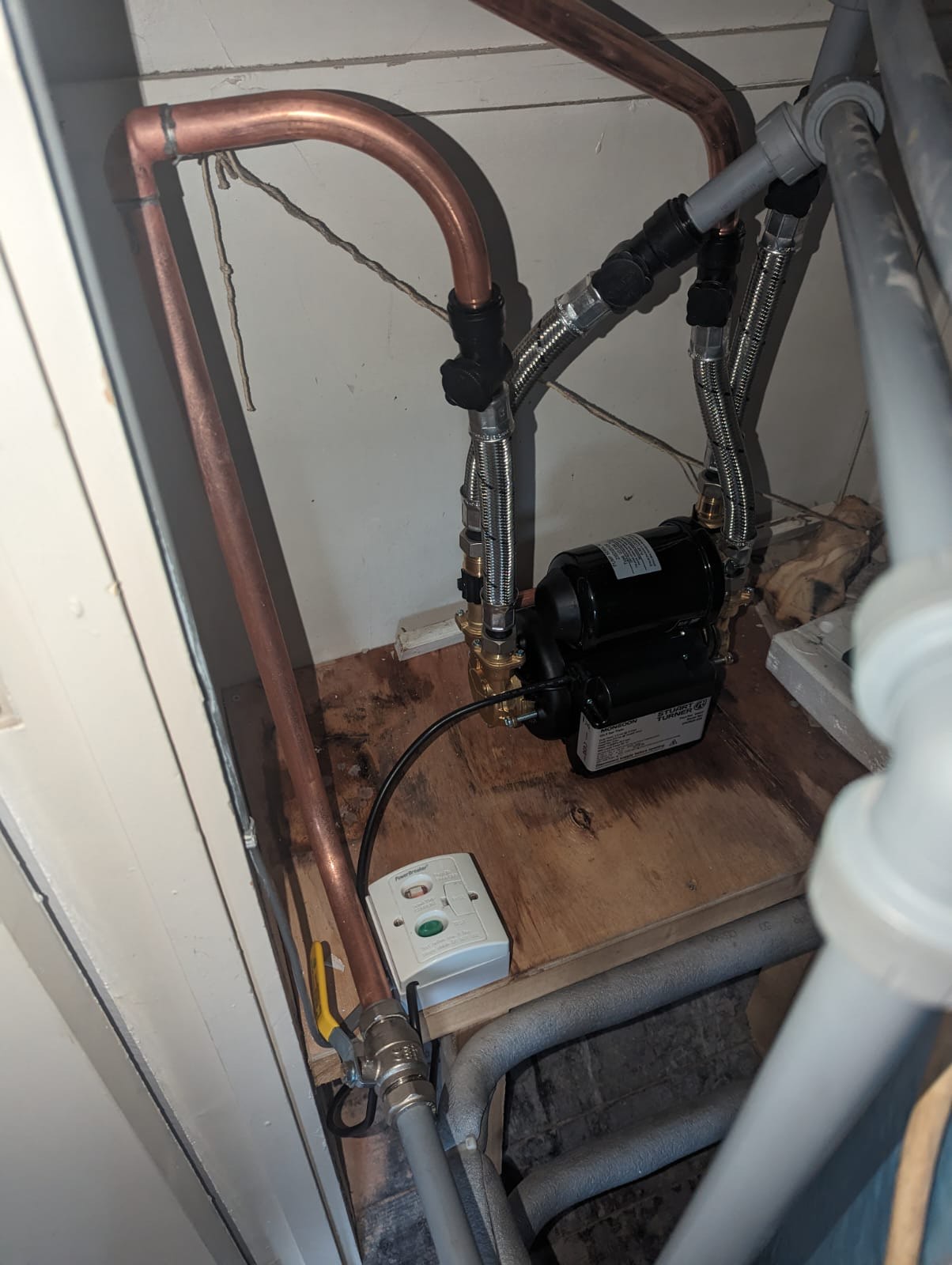
Central heating pump installed and wired by our engineersOur own work · Gas Safe 951167
What we actually do
- Check the system first and confirm a flush is the right answer. Sometimes it is a seized valve or a failing pump, and a flush would not have helped.
- Connect a flushing unit and circulate cleaner at high velocity, reversing the flow to shift debris that has settled.
- Work radiator by radiator so each one clears rather than flushing the loop and hoping.
- Flush through until the water runs clear, then dose the system with inhibitor.
- Balance the radiators afterwards so the heat is spread properly rather than all going to the first one on the run.
When a flush is not the answer
We would rather talk you out of one than sell you a job you do not need. If your radiators are cold at the top, bleed them. If one radiator is cold and the rest are fine, it is more likely a stuck valve. If the boiler is losing pressure, that is a leak or an expansion vessel, not sludge. A flush is for a system that is genuinely dirty throughout.
For the background on how sludge builds up and what it does to a boiler, our guide to power flushing central heating goes into more depth. If your boiler is on its way out anyway, a replacement may be the better spend, and we will say so.
Common questions
How do I know if my system needs a power flush?
The usual signs are radiators cold at the bottom but warm at the top, some radiators never heating at all, a boiler that is noisy on start-up, or dirty black water when you bleed. Cold at the BOTTOM is sludge. Cold at the top is air, and that only needs bleeding, which you can do yourself.
How long does it take?
Most domestic systems take the better part of a day. Bigger systems, or ones that have never been cleaned, can run longer. We will tell you what we expect before we start rather than discovering it halfway through.
What does it cost?
It depends on the number of radiators and how bad the system is, so we quote it properly rather than guessing. Ring 01732 792 454 and tell us roughly how many radiators you have and what the symptoms are.
Will it fix my cold radiators for good?
It fixes the cause, which is circulating debris. Whether it stays fixed depends on what happens next: a system with no inhibitor will silt up again. We add inhibitor as part of the job and will tell you honestly if a magnetic filter is worth fitting.
Is a power flush the same as a chemical flush?
No. A chemical flush circulates cleaner through the system at normal pressure. A power flush uses a pumping unit to push water through at high velocity and actually shift the debris out. The right one depends on how bad the system is, and we will say which yours needs.
Do I need one before a new boiler?
Often, yes. Fitting a new boiler onto a dirty system pushes existing sludge straight into the new heat exchanger, and most manufacturers require the system to be cleaned for the warranty to stand. We build this into the quote where it is needed.
Radiators not heating properly?
Tell us how many radiators you have and what they are doing, and we will tell you whether a flush is what you actually need.